What Has The Camera Captured In The Poem A Photograph?
What the Camera Captured: A Deep Dive into Shirley Toulson's "A Photograph"
Shirley Toulson's poignant poem "A Photograph" masterfully uses a simple snapshot to explore profound themes of time, memory, loss, and the ephemeral nature of human existence. The camera, in this context, is far more than a mere device; it is a silent witness, a frozen moment in time that serves as a conduit to the past, holding within its frame a narrative that unfolds across generations.
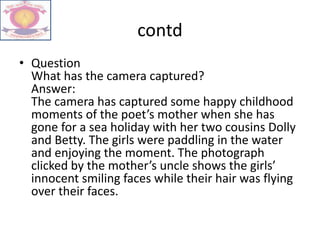
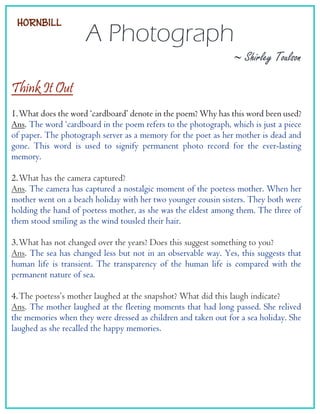
At its most literal level, the camera in "A Photograph" has captured a joyous, carefree moment from the poet's mother's childhood. The image depicts three young girls on a beach holiday: the poet's mother, then a twelve-year-old with a "sweet face," flanked by her two younger girl cousins, Betty and Dolly. They are described as "paddling" in the shallow water, their "terribly transient feet" a subtle foreshadowing of life's fleetingness. Their "smile through their hair" at the uncle with the camera evokes a sense of innocent delight, a snapshot of youthful exuberance untainted by the complexities of later life.
However, the camera's capture extends far beyond this initial, visible scene. It has also immortalized:
-
Innocence and Youth: The photograph is a testament to a time of unburdened happiness. It captures the unadulterated joy of childhood, where the greatest concern was perhaps the next wave or the playful splashing of water. This innocence, once tangible, becomes a spectral presence in the later stanzas, highlighting the stark contrast with the weight of adulthood and loss.
-
The Mother's Past Identity: For the poet, the photograph offers a glimpse into her mother's life before she was a mother. It allows the poet to connect with a younger version of her parent, a girl full of life and promise. This past identity is crucial, as it emphasizes the transformative power of time and the multifaceted nature of an individual's journey.
-
The Unchanging Nature of the Sea: In contrast to the "transient feet" of the girls, the poem notes that the "sea... appears to have changed less." The camera, by capturing both the fleeting human figures and the enduring seascape, implicitly highlights the permanence of nature against the impermanence of human life. The sea, a silent observer of countless generations, remains largely unaltered, serving as a constant backdrop to the ever-shifting human drama.
-
The Seeds of Nostalgia: The photograph becomes a powerful object of nostalgia, not only for the poet's mother in her later years, but also for the poet herself after her mother's passing. The camera's capture of this moment allows for a reliving of the past, albeit with the bittersweet realization that those times are gone forever. The "laboured ease of loss" that the poet feels is intrinsically linked to the vivid memories evoked by the image.
-
The Inevitability of Loss and the Passage of Time: Ultimately, the camera, in its act of freezing a moment, underscores the relentless march of time. The joyful image, once a present reality, becomes a relic of the past. The mother's laughter, once vibrant, is reduced to a memory. The photograph serves as a stark reminder that life is a continuum of moments, each passing into the realm of memory, culminating in the ultimate silence of death. The camera captures a moment before the twelve years that have passed since the mother's death, emphasizing the finality of absence.
In essence, the camera in "A Photograph" has captured not just a physical scene, but a complex tapestry of emotions, memories, and profound truths about human existence. It is a powerful symbol of how a seemingly simple object can hold within its frame a lifetime of stories, allowing us to connect with the past and reflect on the universal experiences of joy, change, and enduring grief.
What Has The Camera Captured In The Poem A Photograph Wallpapers
Collection of What Has The Camera Captured In The Poem A Photograph wallpapers for your desktop and mobile devices.














Download these What Has The Camera Captured In The Poem A Photograph wallpapers for free and use them on your desktop or mobile devices.
